September 11, 2010

Update: new doctor pulls out of coming to PEI

**UPDATE**


Sadly, Dr Rawal has informed us that she has decided not to come to PEI.   We have been talking to her about her move here for over two years, and we are terribly disappointed that she has decided against coming.

This is a terrrible blow to our plans for the medical practice.  We have been working hard over the last few months planning for the expansion of the practice, and we are very disappointed by this news.

It means that we will not be able to provide the level of service to our patients that we would like.  We won't yet be able to provide the extended opening hours that we were planning.   We won't yet be able to stay open during the doctor's vacations.  We won't yet be able to provide the stability and sustainability that comes with a group practice.


We are actively looking for more doctors, and so we are hopeful that this is just a temporary setback.


Original post:


Our goal is to make sure that every patient in PEI has easy access to a family physician.  To do this we plan to keep our doors open to new patients.  Instead of closing our doors, as we register more patients we plan to add more doctors to our medical practice to meet demand.

As part of this plan, we have now appointed our second doctor.  Dr Susan Rawal is a GP (family physician) in England.  She is currently a partner in a medical practice with 21,000 patients.  However, her husband has taken a job as a radiologist at the QEH hospital in Charlottetown and they will be moving to PEI this year with their three young children.  Dr Rawal has kindly asked Health PEI if she can join our practice when she arrives and Health PEI have agreed to this.

The addition of a second doctor will make us a 'group practice'.  This means that all of our patients will have access to both doctors.  Patients will be able to book an appointment with the doctor of their choice.

We plan to continue to add more doctors to the practice as we grow over the next two to three years, and have a capacity in our current premises for up to 4 doctors and 12,000 patients.  We have also been approached about the possibility of opening a branch practice in the future in Prince County to tackle the physician shortage there.

This is fantastic news for the residents of Queens County who have struggled with a shortage of family physicians for so long.  Once up and running our medical practice will have the following advantages:

  • A choice of which doctor you see when booking in advance.
  • A choice of a female or male doctor depending on your needs.
  • A medical practice that is never closed for vacations.
  • A new 'Rapid Access Clinic' which will allow patients to see a doctor within 48hours for urgent conditions.
  • A planned joint injection clinic.
  • Patients will not 'lose' their family physician if one doctor leaves.  Even if one doctor leaves the group practice, the other doctors can carry on until a replacement is found.  This will hopefully mean an end to thousands of patients suddenly finding themselves without a family doctor. 
    To do this we need to successfully attract and retain high quality family doctors to PEI over the next two to three years.   Because we are a modern, paperless, medical practice with a team of nurses and doctors working together, it is easier for us to attract doctors to the province:
    • We operate the style of medical practice that modern family physicians are used to elsewhere.
    • We have already been contacted by several Canadian doctors who have seen us on the internet and are interested in moving to PEI.  
    • Our Health Care Technicians will be taking their Canadian exams over the next couple of years and may be able to become physicians within the practice once they obtain Canadian licenses.   
    • One of our Health Care Technicians, Shirin Majdi Zadeh, will be leaving us to start her Family Practice intern training in the US in November.   We would be delighted if she chose to return to work with us in three years time when she is a fully qualified family doctor.
    • Every month we are visited by doctors and people in health-related fields from around Canada interested in how we have set up our medical practice.

      We are delighted to be able to continue our work to improve access to high quality care and I'm sure all our patients will be as excited as we are about Dr Rawal coming to join us in January.

      August 14, 2010

      Dr Fox - Cognitive Behavioural Therapy (CBT)

      Dr Declan Fox, Family Physician
      Dr Declan Fox is visiting our practice for a three week period and will be seeing patients on Friday afternoons.

      Dr Fox is a Northern Irish GP (Family Physician) who is experienced in Cognitive Behavioural Therapy (CBT).  CBT is commonly called "talking therapy".   It is very effective for patients with anxiety, depression, stress, insomnia, post-traumatic stress disorder, chronic pain, and panic attacks.

      Dr Fox has been coming to work in PEI for around 10 years now - mainly over in West Prince.  He is completing his diploma in CBT, and will be returning to visit our practice again next year.  On his next visit, as well as seeing patients, he will be training our nursing staff in how to support patients who are using self-directed CBT.  That is, CBT using the excellent self-help website Living Life to the Full and the self-help books written by Professor Chris Williams of Glasgow University. We have several copies of Dr Williams' books Overcoming Depression and Overcoming Anxiety in our medical library.  These books are available to our patients to take out on loan.

      If you would like more information about CBT, please book an appointment with one of our Practice Nurses.

      CBT practitioners are sadly quite rare, and we'd like to thank Dr Fox for taking the time to help out our patients and staff.  We are sure that the patients who meet him will find him as thoughtful, helpful and caring as we do.

      August 7, 2010

      Colour coded staff uniforms

      We are a large medical practice with a large team. It's important that patients, staff and visitors can easily and quickly identify different staff groups. This improves safety and efficiency.

      That is why we have standardised staff uniforms that are colour coded.

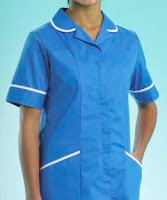
      Registered Nurses wear navy blue tunics. Licensed Practical Nurses (LPNs) wear 'hospital blue' tunics. Health Care/Pharmacy Technicians wear white tunics.


      Registered Nurses (RNs) wear navy blue tunics


      Licensed Practical Nurses (LPNs) wear 'hospital blue' tunics


      Health Care Technicians and our Pharmacy Technician wear white tunics


      Receptionists wear a black and white pattern tunic.


      The licensed physicians, our Practice Pharmacist, and the management team will continue to wear street-clothes ('civvies').

      The staff uniform color coding for our Sherwood practice and our Strachur practice are based on the Scottish National Health Service (NHS Scotland) national uniforms (although we are still using the 'old' uniform style which is more appropriate for primary care) and the NHS Scotland staff dress code.

      July 23, 2010

      Practice reopening

      **UPDATE**

      The practice is reopening today (Monday) at 1pm.

      Apologies to any patients for any disruption.


      __________________________

      The practice staff have received a telephone call from a known violent offender which could be construed as posing a threat of serious violence involving the use of a firearm.

      As a result the medical practice is currently locked down. Police officers are in attendance at this time.

      Patients are advised not to attend the practice which will remain closed at least until Monday afternoon.

      We will update this site with more details as they become available.

      Collaborative care will not mean less doctors on PEI

      CBC ran a story yesterday about a leaked copy of the draft Hay report into the future of health care on PEI.

      I've not read the report, but they make reference to a suggestion that the number of doctors in PEI may be cut. This could obviously cause concern for patients and doctors who might be worried about the effect this might have on their care.

      No matter what the report contains, the changes in health care will not reduce the need for doctors in the province. Improvements in health care delivery will mean better care for patients. However, there are lots of reasons why the number of doctors won't be able to be safely reduced in the foreseeable future:

      1. There is a huge unmet health need. Better working will help meet, but will not exceed this need.

      2. The population is aging.

      3. As care improves, people need more care for the complex chronic illnesses that they are living longer with.

      4. It will take 15 years to introduce changes across the health care system.

      5. As the use of nurses and technicians increases, they will become an increasingly valuable resource, slowing the rate of change and increasing costs.

      I'm looking forward to reading the final report when it is published.

      July 11, 2010

      Updated Practice Leaflet and website

       We've updated our practice leaflet (our guide for our patients) and our website.

      The leaflet was last updated in January, and we've moved offices and had several new members of staff join us since then.  The leaflet has also had it's information about our services updated, and has up to date opening hours included in it.

      Please download a copy of the new patient leaflet, print it out, and keep it by your phone.  Or pick up a fresh copy from the practice when you are next in.

      July 4, 2010

      SIGN Rockets - Aiming for Best Practice


      If you are a hockey fan googling for 'PEI Rockets Sign' and you ended up here a little confused, I apologise.

      SIGN guidelines have revolutionised the standard of medical care over the last fifteen years.  They are a series of guidelines produced by the Scottish Intercollegiate Guideline Network and are arguably the best guideline network in the world.  The fact that they are made in Scotland - like so many other wonderful inventions - helps, of course.  The key thing is that they are unbiased.  Vitally, the are completely independent of any pharmaceutical industry influence.  This is because they are funded centrally by the National Health Service in Scotland (they are part of NHS Quality Improvement Scotland)  and don't have to rely on any outside industry funding*.

      The national guidelines are now an established part of all family practice in Scotland.  Many of our patients with chronic issues will have come across them already as our Practice Nurses use them in both of our clinics as the basis for our Chronic Issues Reviews.  So, if you have higher blood pressure, or diabetes, or chronic bronchitis, our nurses will use the SIGN guidelines for those conditions as part of your review.  (Specialists may also have noticed that our referral letters to them are based on SIGN Guideline 31: Report on a Recommended Referral Document.)

      Basically, the guidelines tell us what we should be doing to provide the best care possible to our patients.  This is called Best Practice.  They do this by evaluating all the available evidence and then grading their advice based on how good the evidence is.  They do this using the Canadian ABCD system - each point has a letter next to it to show how good the evidence is for that advice/treatment.  A is the highest quality, D is the lowest quality.  Often, low quality evidence is because something is very hard to measure, and so is very hard to prove.

      Now, SIGN is moving from simply telling us what the evidence is to helping us to actually put that in to practice.  One part of that move is the introduction of SIGN Rockets.  Rockets stands for Recommendations Online: Clinical Knowledge Evidence Translation.  I prefer to think of them as a fast vehicle which takes us (including the patient) on a journey of best care.  (There are other vehicles that we use for this too - such as the excellent 'best BETs' evidence based medical care website or the English National Health Service's Clinical Knowledge Summaries, although sadly you need access to an NHS Proxy Server to use the later).

      So, if you come to us with a breast lump, don't be alarmed if we start to talk to each other about putting you on a rocket!  The medical team will simply be making sure that we get you on the path to the best possible care.  This will involve the medical and nursing teams working together using the appropriate SIGN Rocket.

      Anyone can read and/or download the SIGN guidelines that we use.  They are available on the SIGN website.


      *   In my medical practices I have a have a near-total ban on any information leaflets, guidelines, or equipment that has been funded - even in part - by the pharmaceutical industry.  SIGN are therefore a 'trusted' source of information for us that makes it much quicker and easier to implement good care.  We know straight away that the guidelines are free of outside bias.  In fact, they even have a guideline for the creation of guidelines!  We use other guidelines but - of course - that takes much longer as we need to research the guideline before we can be sure we can trust it.